The Icelandic Met Office Aurora Forecast
The Icelandic Met Office at vedur.is publishes the most trusted aurora forecast for Iceland. The site shows two essential pieces of information: cloud cover maps for the coming hours and current auroral activity measured on the KP index scale from 0 to 9.
The cloud cover map updates every few hours and displays forecast cloud density across Iceland in shades of white and grey. Dark areas indicate clear skies, while dense white patches show thick cloud that will block your view of any aurora overhead. Most tour operators check this map multiple times during the afternoon to choose their driving route for the evening.
You can view the forecast in three-hour intervals stretching from evening through night into early morning. This lets you see whether conditions will improve after midnight or if clouds will roll in later, helping you decide whether to join a northern lights bus tour reykjavik or wait another night.
Understanding the KP Index Scale
The KP index measures geomagnetic activity on a scale from 0 to 9, where 0 represents no activity and 9 indicates an extreme geomagnetic storm. This scale originates from monitoring stations worldwide that detect disturbances in Earth's magnetic field caused by solar wind.
Iceland sits at approximately 64 to 66 degrees north latitude, which means you can see aurora borealis at relatively low KP values compared to destinations further south. A KP of 2 or 3 often produces visible aurora displays across Iceland, while KP 0 or 1 typically means aurora remains faint or invisible without specialized camera equipment.
KP values of 4 or higher bring stronger displays with more movement, brighter greens, and occasionally red or purple hues in the upper atmosphere. These higher values also push the aurora oval further south, making it visible overhead rather than just on the northern horizon. During northern lights iceland march and autumn equinox periods, geomagnetic activity tends to peak, delivering more nights with elevated KP values.
The forecast updates every three hours based on solar wind measurements from satellites positioned between Earth and the Sun. These satellites detect changes in solar wind speed and density roughly 30 to 60 minutes before the particles reach Earth's magnetosphere.
Book Northern Lights Tours from Reykjavik
More tours on GetYourGuideWhy Cloud Cover Matters More Than KP
Even a KP index of 5 or 6 delivers no visible aurora if thick cloud sits between you and the sky. Cloud cover is the single most important factor for successful aurora viewing in Iceland, which explains why tour operators spend more time studying weather maps than solar activity charts.
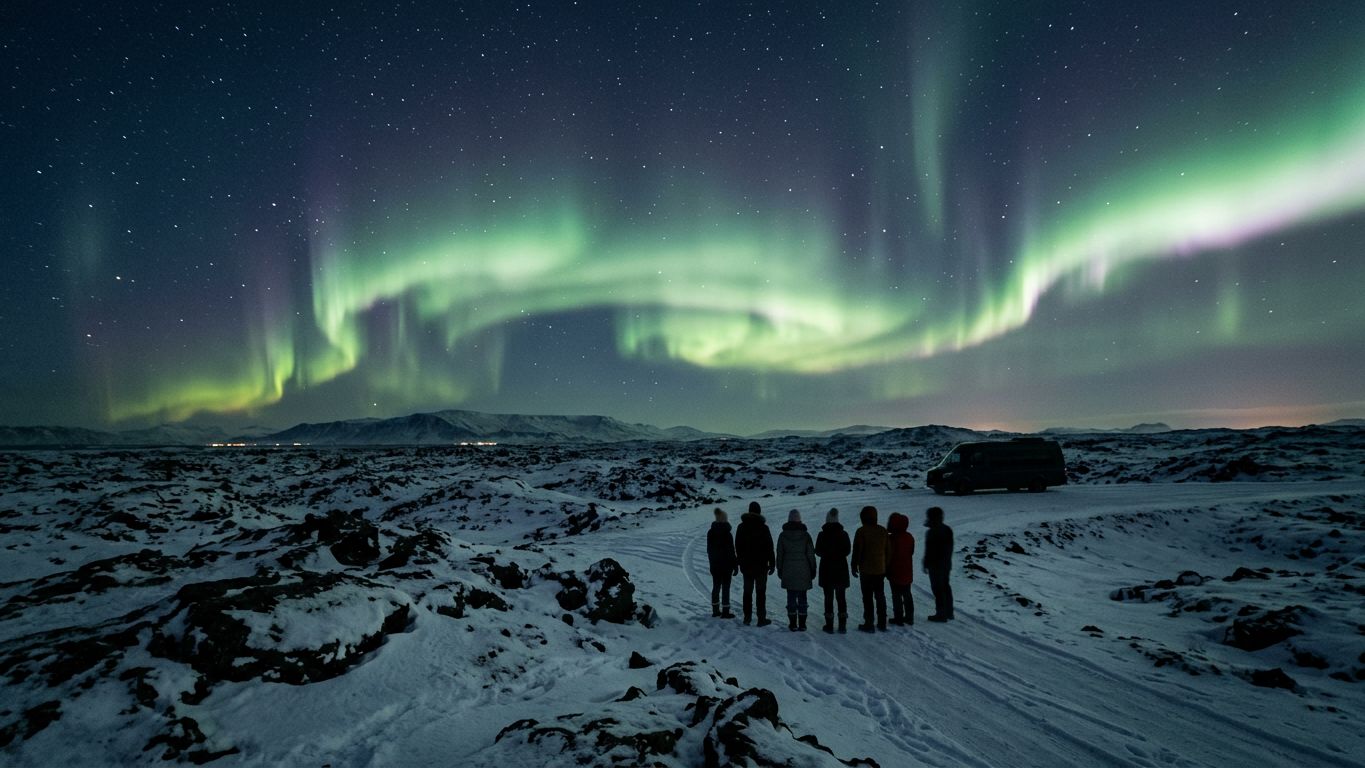
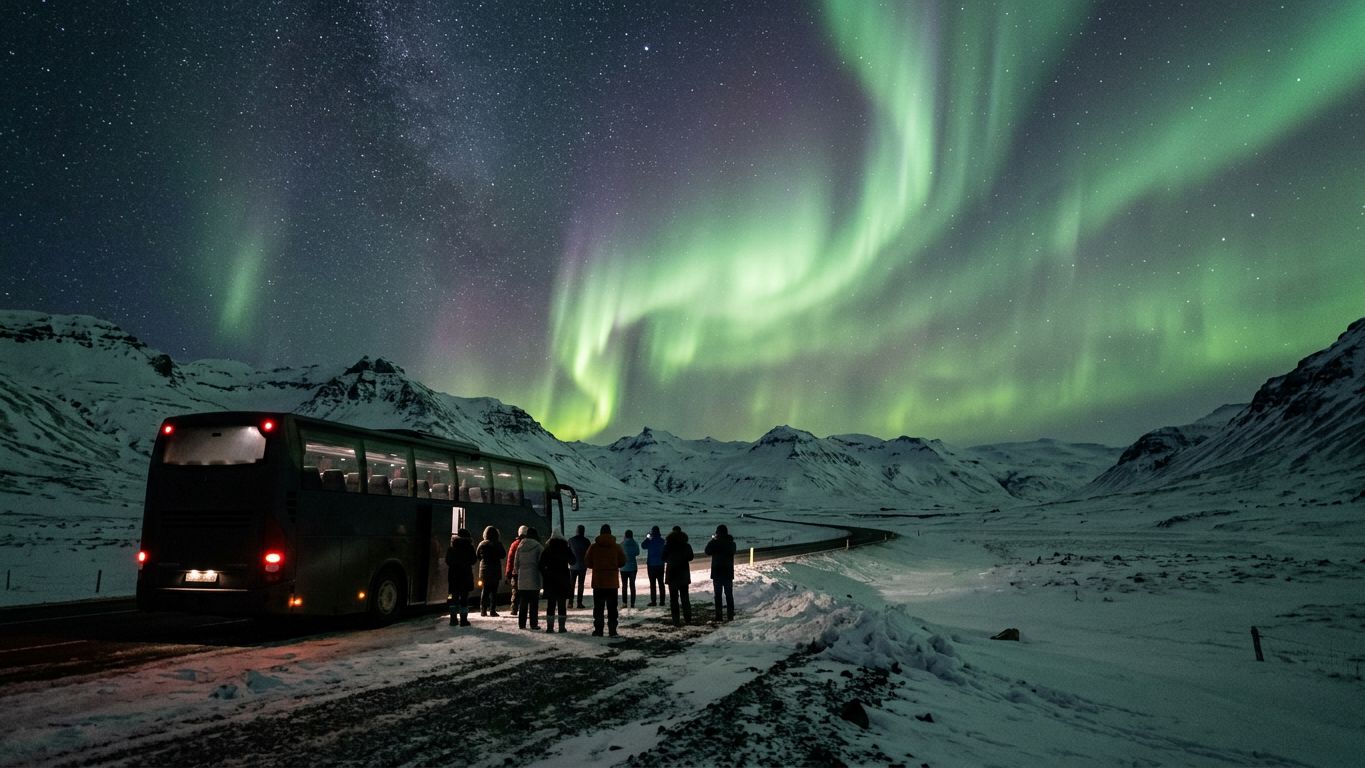
Iceland's maritime climate brings rapidly changing weather patterns, with cloud formations that shift and break up throughout the night. A cloudy forecast at 21:00 might clear by 23:00, or a clear start might cloud over after midnight. This unpredictability is why many northern lights tour iceland reykjavik operators drive significant distances each evening, sometimes 60 to 90 minutes from the city, chasing clear sky pockets.
Light pollution becomes a secondary consideration after cloud cover. Even under clear skies, you need reasonably dark surroundings to see faint aurora. Thingvellir northern lights viewing areas lie about 45 minutes from Reykjavik and offer almost no artificial light, making them popular destinations when the forecast shows clear skies in that region.
How Solar Activity Creates Aurora
Aurora borealis results from charged particles in solar wind colliding with gases in Earth's upper atmosphere. The Sun continuously releases streams of electrons and protons that travel through space at speeds between 300 and 800 kilometers per second, taking roughly two to four days to reach Earth.
When these particles encounter Earth's magnetosphere, the planet's magnetic field channels them toward the polar regions. As particles collide with oxygen and nitrogen molecules at altitudes between 100 and 400 kilometers, the gases emit photons of light. Oxygen produces green and red colors, while nitrogen creates blue and purple hues, though red and purple appear only during strong geomagnetic activity.
Coronal mass ejections and solar flares increase the density and speed of solar wind, boosting the KP index and aurora intensity. Space weather forecasters monitor sunspot activity and solar eruptions to predict periods of heightened auroral displays several days in advance, though exact timing and intensity remain difficult to forecast with precision.
The aurora oval, a ring-shaped zone centered on each magnetic pole, expands and contracts based on geomagnetic activity levels. Iceland's position just below the Arctic Circle places it near the southern edge of this oval during quiet periods and well within the zone during active periods, which is why aurora remains visible throughout the season from late August through mid April as explained in best time to see northern lights in iceland.
What KP 2-3 Means for Iceland
Most successful aurora viewing nights in Iceland occur at KP values between 2 and 3. These moderate levels produce visible green bands and arcs that move slowly across the northern sky, often lasting several hours with varying intensity.
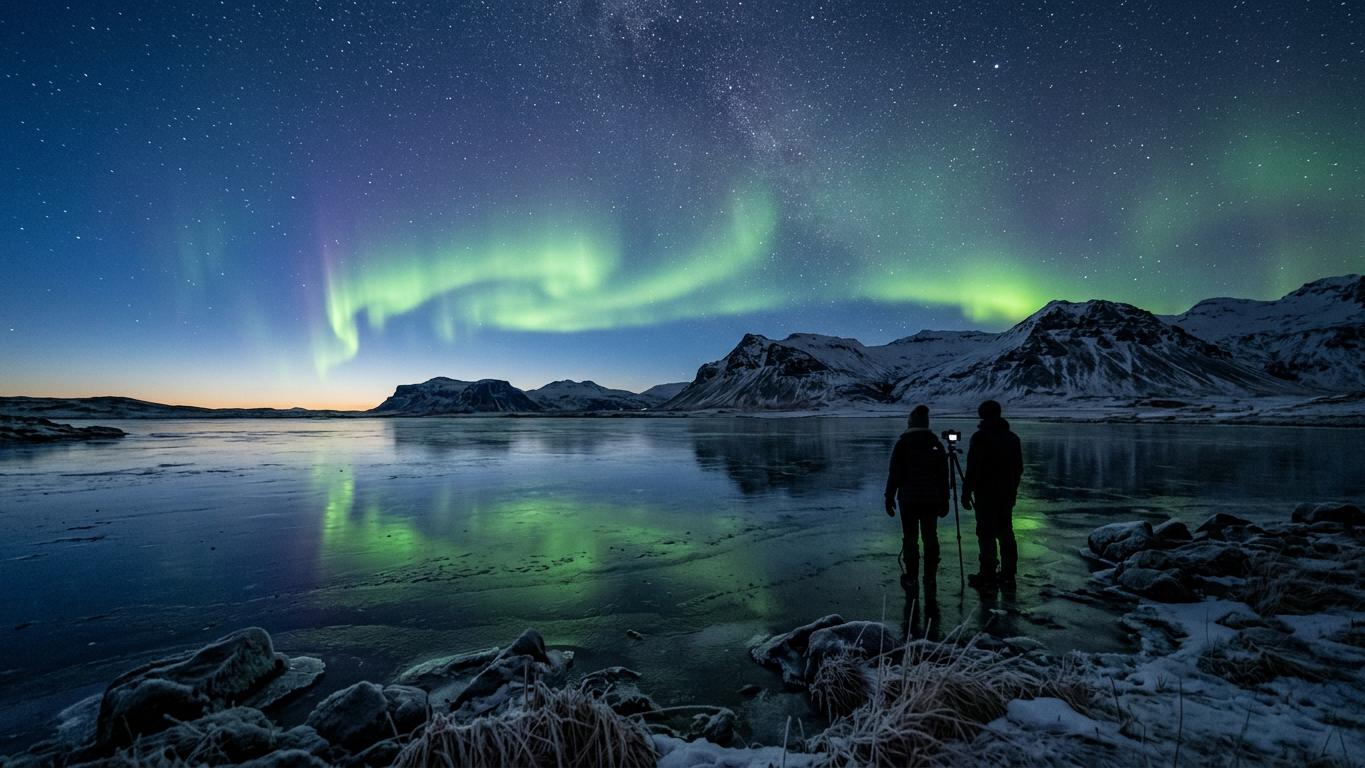
At KP 2, you typically need clear dark skies and some patience. The aurora may appear as a faint greenish glow on the horizon that brightens periodically. Camera sensors detect these displays more easily than human eyes, which is why northern lights photography tour iceland operators can capture impressive images even when the aurora looks subtle to participants.
KP 3 brings brighter displays with more defined structures like curtains, rays, and spirals. Movement becomes more noticeable, with waves rippling through the aurora bands. These displays often fill a larger portion of the sky rather than remaining confined to the northern horizon, making them easier to spot and more satisfying for first-time viewers.
Tour operators generally proceed with departures at KP 2 or above, provided the cloud forecast looks favorable. Below KP 2, many operators will still run tours if skies are forecast to be perfectly clear, since even faint aurora provides a worthwhile experience for visitors who may have limited time in Iceland.
How Tour Operators Use the Forecast
Tour operators check both the aurora forecast and detailed weather models throughout the afternoon before making final decisions about routes and departures. Most companies monitor the Icelandic Met Office forecast alongside additional weather services that provide hyperlocal cloud predictions.
The decision to run or cancel typically happens between 16:00 and 18:00 each day during aurora season. Operators consider the KP forecast, cloud cover predictions from evening through midnight, wind speeds that might affect passenger comfort, and road conditions if they plan to drive to more remote locations like south coast iceland northern lights viewing areas.
Some operators adjust their routes hour by hour, communicating with other drivers in the field about which areas have clearer skies. This coordination helps explain why small group northern lights tour reykjavik options often succeed more frequently than independent attempts, since professional guides can access real-time information from multiple sources and change plans quickly.
If conditions look marginal but not impossible, most operators will depart and give themselves two to three hours to find breaks in the cloud. A KP of 3 with 50 percent cloud cover offers better chances than KP 5 with 90 percent cloud cover, demonstrating again why clear skies outweigh high solar activity in practical terms.
Free Rebooking Policies Explained
Most aurora tour operators in Iceland offer free rebooking if tours run but no aurora appears due to cloud cover or low solar activity. This policy differs from a refund: you receive another opportunity to join a tour on a different night rather than getting your money back.
The rebooking guarantee typically applies when tours depart but aurora remains invisible throughout the evening. If operators cancel before departure due to obviously poor conditions, you can usually rebook without restriction. If you choose not to join a departure that goes ahead, rebooking policies may not apply, so checking the forecast yourself helps you make informed decisions about whether to go out on marginal nights.
These policies acknowledge that aurora viewing carries inherent uncertainty. Even with perfect forecasts, nature may not cooperate. The rebooking option gives you multiple attempts during your Iceland visit, significantly improving your overall chances of success. Visitors staying a week can often secure three or four tour opportunities, making it likely they will experience at least one clear night with visible aurora.
Premium options like private northern lights tour reykjavik services typically offer the same rebooking terms, though cancellation windows may require more advance notice due to dedicated vehicle and guide assignments.
Your Evening Aurora Checklist
Before heading out to look for aurora, whether independently or on a tour, run through this practical checklist to maximize your chances and comfort. Start by checking the Icelandic Met Office forecast around 17:00 or 18:00 for current KP values and evening cloud predictions.
Dress in multiple warm layers including thermal base layers, insulating mid-layers, and a windproof waterproof outer shell. Icelandic winter temperatures typically range from minus 5 to plus 5 degrees Celsius, but wind chill can make it feel much colder during long periods standing outdoors. Bring a warm hat, gloves, and insulated boots rated for cold weather.
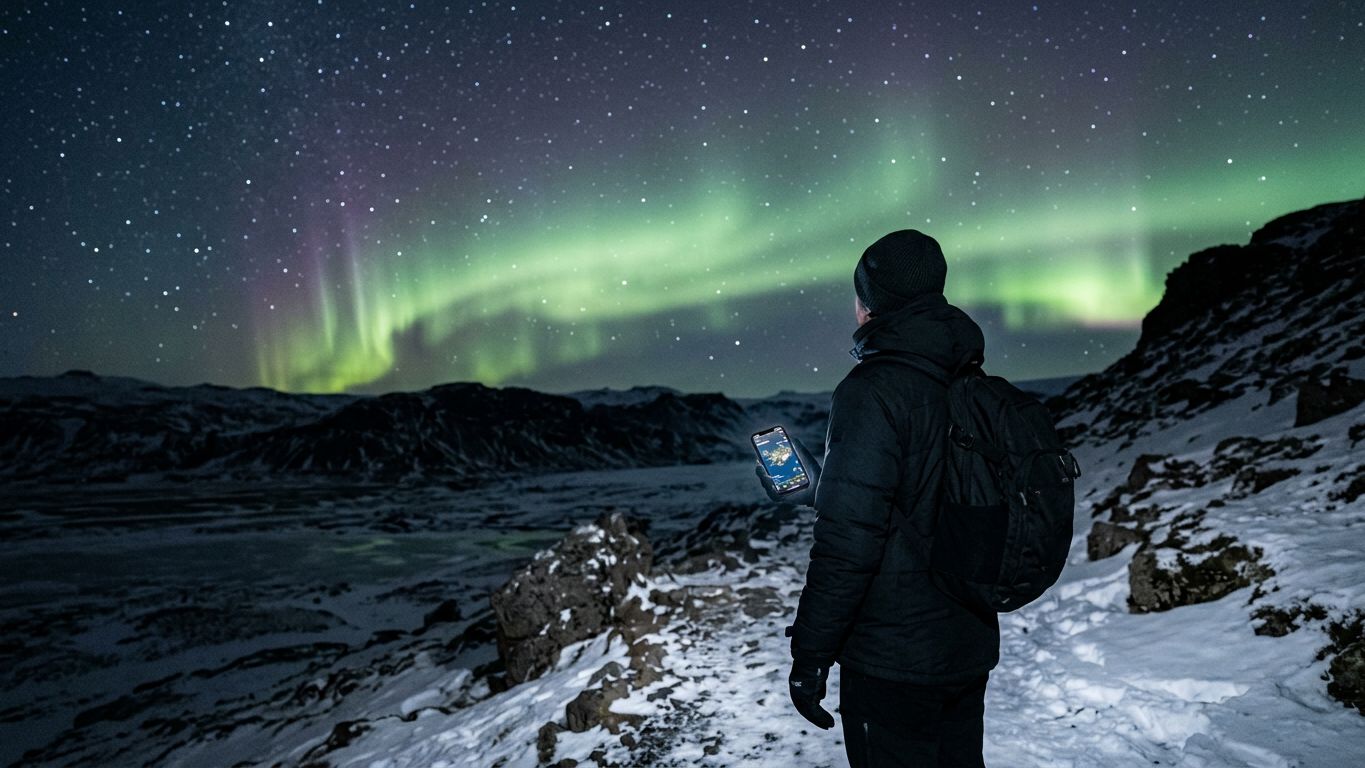
If you are driving yourself, identify two or three potential viewing locations with different sky orientations so you can move if cloud blocks your first choice. Download the vedur.is forecast map to your phone before leaving, since mobile coverage becomes sparse outside Reykjavik and major towns. Locations like northern lights reykjavik spots around Grótta lighthouse or Öskjuhlíð hill work well for last-minute attempts without driving far.
Charge your phone and camera batteries, since cold temperatures drain them faster than usual. Bring a tripod if you want to photograph the aurora, and set your camera to manual mode with a wide aperture, high ISO between 800 and 3200, and shutter speed between 5 and 15 seconds as a starting point.
Allow your eyes 20 to 30 minutes to adapt to darkness before expecting to see faint aurora clearly. What looks like grey cloud to your daylight-adjusted eyes often reveals itself as green aurora after your vision adjusts. Plan for at least two hours outdoors, since aurora activity fluctuates and you may need to wait through quiet periods before brighter displays appear.
Frequently asked questions
How accurate is the northern lights forecast for Iceland and when should I check it before going out?
The Icelandic Met Office forecast at vedur.is is highly accurate for cloud cover predictions three to six hours ahead, though weather can change rapidly in Iceland. Check the forecast around 17:00 or 18:00 for the most reliable picture of evening conditions. KP index predictions are generally accurate for the current reading but become less reliable more than six hours ahead due to variable solar wind speeds.
What KP index do I need to see the northern lights clearly from Reykjavik or nearby viewing areas in Iceland?
You can see aurora from Reykjavik and surrounding areas at KP 2 or higher, provided skies are clear and you are away from bright street lights. KP 3 produces more vivid displays with better visibility even from semi-urban locations. At KP 4 or above, aurora becomes bright enough to see despite moderate light pollution, though darker locations always offer better viewing.
If the cloud forecast shows 40 percent cloud cover but the KP index is only 2, should I still try to see the northern lights in Iceland tonight?
Yes, 40 percent cloud cover with KP 2 offers reasonable chances of seeing aurora if you can position yourself under the clear patches. Cloud rarely covers the entire sky uniformly in Iceland, so breaks in the cloud often reveal aurora overhead. This scenario typically prompts tour operators to proceed with departures, though they may drive further than usual to reach clearer areas.
Why do northern lights tours from Reykjavik sometimes cancel even when the KP index forecast looks good at 3 or 4?
Tours cancel primarily due to cloud cover predictions, not low KP values. A KP of 3 or 4 means strong aurora activity, but if the forecast shows complete cloud cover across accessible regions, operators cancel because thick cloud makes aurora invisible regardless of solar activity levels. Road conditions and severe weather warnings also trigger cancellations even when aurora forecasts look promising.
How do tour operators in Iceland decide where to drive when looking for clear skies and northern lights each evening?
Operators study the Icelandic Met Office cloud cover maps to identify regions forecast to have the clearest skies, then plan routes to those areas that are accessible within reasonable driving time from Reykjavik. They monitor real-time updates from other guides already in the field and adjust routes during the tour if cloud conditions change, often driving 60 to 90 minutes to reach clear viewing spots.
What does the free rebooking policy mean if I take a northern lights tour in Iceland but we don't see anything?
Free rebooking means you can join another tour on a different night at no additional cost if your original tour runs but aurora remains invisible due to clouds or very low solar activity. You do not receive a cash refund, but rather another attempt to see the aurora. This policy typically applies during your current Iceland visit and does not carry forward to future trips.
Can I see the northern lights in Iceland during a full moon or does moonlight make the aurora forecast less favorable?
You can see aurora during a full moon, though bright moonlight reduces the contrast and makes fainter displays harder to spot with your eyes. Strong aurora at KP 3 or higher remains clearly visible during full moon periods. The aurora forecast does not factor in moon phases because moonlight affects visibility rather than aurora occurrence, so clear skies and decent KP values still indicate good conditions.
What is the difference between the KP index and cloud cover when reading the northern lights forecast for Iceland?
The KP index measures solar activity and magnetic disturbance levels that create aurora, while cloud cover indicates whether you will be able to see the aurora through the weather. High KP means strong aurora exists in the atmosphere, but thick cloud blocks your view from the ground. Clear skies with low KP may show faint aurora, while cloudy skies with high KP show nothing, making cloud cover the more critical factor for planning.